Monday, 29 June 2015

Project Update June 2015


Yipeeeeeee! The Brine Shrimp Hatchery is dismantled and back in the garage till next year and the conservatory is back doing what it was built for.... Drying bread.
 
Before we go on, we must make one thing very clear; we are never going to surpass, or even match, the quality of the images in the last blog. Everything was just perfect; light levels, water clarity, and we just happened to be in the exact right place, with finger on camera shutter, at just the right time. So it’s all downhill from now on...... Which is why we have left it so long to do another, but here goes.
The unusually cold April and May continued to slow everything (including us).
Warmth, as well as getting the right food, and the right amount of food in them, is key to the little roach growing and developing and the cool start meant that while we could almost see them growing before our very eyes; which is usual, they weren’t doing so at the rate we are used to.
We struggled with daphnia production too, which we regard as a vital live supplement to the crumb they get when the Brine Shrimps have finished. Ordinarily, we put cabbage and cauliflower leaves in the tanks and barrels and as these begin to soften and release their fluids the daphnia bloom and we can keep cropping and depositing them in the tanks where they squirt out live young every week or so which are perfect for our young roach. This year the temperature of the water meant that all we were doing was preserving and refreshing the cabbage leaves and making them extra sweet and crunchy.
The first few weeks are always the trickiest for us, and our roach, with there being no leeway or flexibility. Once the yolk sac is taken up the little fish must have food regularly which we will hopefully have made sure there is an abundance of with induced algal blooms in all the tanks (they can’t call upon stored fat reserves).
Interestingly (or are we just being geeky again?) we have a little microscope and look at the water regularly to see the volume of little critters darting about in it, and it is astonishing how quickly our little roach clear this microscopic life from the tanks.
What is also astonishing is how everything responds to a bit of warmth and sunshine; none more than us two.
The roach begin to pack on the weight (bit like us two), the tanks green up like pea soup, the daphnia proliferate and continue supplying our roach with their protein packed live young, we can lift our heads and take a breath and let out yet another quiet sigh of relief and satisfaction.
The only thing we really have to watch and check regularly is the water quality, as warm water and roach pooh can deliver a nitrate spike that could wipe out an entire tank of fish in no time.
With everything ticking over nicely we get into our maintenance and housekeeping routine, especially around our stews at Bickton and, of course, here at Project HQ. We should get on with cleaning the mucky ‘used’ spawning boards that we have once again stacked against the garage wall, but we won’t until the last minute, as usual.
Not content to just roll with it, we are constantly listening for any Roach Project penny to drop or bright idea to light up our little brains, and thanks to the fantastic generosity of our supporters and the funds raised at our annual fundraiser doo, the financial burden of running the project is eased significantly and we are able to consider every opportunity to increase the effectiveness of our efforts.
This year we have had our eye on the reinstatement of a small lake at the head of our stews at Bickton, which we mentioned in an earlier blog.
We have now sorted the plans and gained the required consents and have had a small digger in to excavate a drainage channel to dry the bed of the lake through the summer ready for the main excavation work to start in September.
In this, we will be able to generate a full and healthy, and relatively self-sustaining, population of roach through seeding it with various ages and sizes of our own fish. We’ll start by stocking our ‘Toddlers’; remember them? These were the fish we kept back to see if we could grow adults here at Project HQ that surprised us by spawning in the tank, which triggered all kinds of additional inspirational roachy schemes and ideas. We moved these fish a couple of years ago to our large stew at Bickton where they have flourished and grown into real thumpers.
We’ll also deposit a few adults each year from the other stews just to keep the gene pool strong.
With luck and good management the roach should naturally proliferate in the lake and we’ll be able to net and crop off a percentage every few years for release into the river as they increase their own numbers, as well as collecting considerable amounts of spawn each year for depositing and hatching directly into the river.
As we do with our annual releases and spawn relocation anyway, we will do the same with what we crop from the lake and deliver to various locations far and wide, and through adult and juvenile displacement and migration along with the larval drift from the hatching of tens of thousands of eggs, the entire river will, over time, be touched by our efforts, including stretches we don’t have direct access to.
This lake will add yet another substantial string to our bow. It could turn into our very own little silver mine..... So, fingers crossed.
Good plan eh?
Once again some of our great mates at the Environment Agency have offered to come along and help, on their days off, with the rest of the preparatory clearance work ready for the ‘big dig’ later in the summer.
We’ll sign off and leave it there and let the pictures below do the rest of the talking.

Brine Shrimps out. Trev’s bread groundbait (and, of course our crumb fish feed barrels) back in..... That’s better... Three hours a day saved. Whatever will we do with our time?

Used and abused spawning boards ready to be ignored for far too long. It is interesting (Here we go again with that ‘interesting’ stuff...) that as these drain and dry they pour out all kinds of little aquatic critters and the local nesting birds, even though having never seen them before, take full advantage and introduce their young to the virtues of a seafood diet of Gammarus and various olive nymphs.

So the roach hatch, we worry, the Brine Shrimps are stopped, we worry, the roach are then fed the finest crumb size, we worry, they bulge pink as they fill themselves and begin to grow before our very eyes and we always knew there was no need to worry.

You know what we’re like on this web site; we just can’t resist a close-up of our roach, here just a few weeks old.

It’s impossible to give an idea of scale without some sort of comparable reference, so we use Trev’s sausage-fingers. The tiny roach on his middle finger is just a few days old and was one of the first we saw swimming free.

Even though still just tiny splinters of life, this image shows them at probably more than twice the size, meaning we are getting it right, but this gives some idea of just how tricky this period is for us. Getting the right amount of the right feed into these tiny creatures is vital and we only know when we are getting it wrong when some start to die, and this can be as much from over as under feeding, especially when they are on the crumb.

In a matter of just a few weeks the fish are really packing it on. This image also shows the considerable difference in sizes even at this age. Those little ones who don’t keep up will become food for the big ones.

This image shows one of the faster growers and you can clearly see the fins and tail forming nicely. A proper little Avon Roach.

I can’t believe we have actually put a picture of cabbage leaves in a tank on the internet. Still, as we said at the top of this blog post ‘Everything was just perfect; light levels, water clarity, and we just happened to be in the exact right place, with finger on camera shutter, at just the right time.’ The image does show the daphnia bloom, which is the fuzz just below the leaves.

And it gets worse. We actually took a picture through our microscope of a single daphnia. It does, however, show it full and ready to deposit dozens of live young – perfect baby roach food.

Here you can see our little roach mingling with the daphnia in the tank and enjoying the bounty of newborns.

Polar opposites in terms of scale; from daphnia to digger, but both play an equally important role. The digger begins another exciting stage in the project. Once the lake is reinstated, the roach growing potential could be off the chart.

These are our ‘Toddlers’ in stew zero at Bickton being fed. Some are over half a pound and will do very well in the lake.

These fish already supply us with spawn each year which is relocated and allowed to hatch directly in the river.

This image gives a better idea of numbers of toddlers that will begin the colonisation of the lake. If the excavation goes to plan, we’ll allow it to lay empty over winter then stock in February. This should mean that the toddlers will deliver their first lot of lake spawn in April.


Sunday, 17 May 2015

Roach Spawning and Hatching 2015


We get a bit punch-drunk at this time of year from all that has to be done, with all the fish movements from stews to river and tanks to stews, then the scrubbing and preparation of the tanks in rediness for the next lot of hatchlings. Along with an induced algal bloom, the tanks are seeded with daphnia which we grow in an assortment of bins and barrels around the garden. These thrive on the green algae (if we manage to get it going) and squirt out live young every week or so; so hopefully, by the time we have collected spawn and hatched roach in the tanks, the water will be alive with little critters for them to get started on........ Or do we think too much???
We always place the first round of spawning boards in the river in plenty of time, which is the first week in April, ready for the roach to spawn on the 25th (as they have done on four of the last six years), all the while hoping that Mother Nature will be kind to us and not run us ragged like she did last year with a monster flood, heat wave or mini ice age.
We were dealt a slight surprise this year with the unusually warm beginning to April which, coupled with the clear river, triggered the roach to commence spawning ten days early; something we had only ever known once before - so the starting pistol was fired just as we were getting ourselves into the starting blocks.
Once again, we were rendered dumbfounded as the roach throughout the river from just south of Salisbury down to Christchurch, some twenty miles apart, all began spawning on exactly the same day..... Awesome!
At one location we were treated to something we’d not seen before. In a smallish private stream behind some riverside apartments, the roach hadn’t arrived at the spawning boards, but being as the head of the stream is accessible to us all round and while we were having a coffee break with one of the owners, we noticed the roach about thirty feet below the boards nervously, but obviously on a mission, slowly moving upstream en masse.
It was clear that they seemed nervous in this open and fairly featureless part of the stream, but with an unerring urge to carry on up. They moved only about ten feet in the half hour we were there. It was amazing to watch.
We know that once they reach the boards and get going all inhibitions leave them and they just get on with it, but the approach was something we’d never witnessed. We always thought the upstream advance was a more speedy and determined affair, but then I guess that nervousness and vulnerability means caution needs to be exercised to ensure survival – and besides, what the heck do we know about all this stuff anyway?
By the afternoon of the 15th the roach were all romping away nicely, and with the unusually clear water we were able to get some really good pictures, which you can OD on below......We have!
We never tire of seeing the roach spawning and always spend time taking plenty of photographs. We regard ourselves as very lucky and the feeling of satisfaction and pride we get from seeing them spawning all over our spawning boards – something we have made from a plank and some netting, tied to a rope and chucked in the river – is indescribable (there is much more to it than that, as you know – we’re just being facetious).
Unfortunately, there is also an unpleasant side of watching roach spawning; or at least being there at the time they are spawning, and that’s seeing the remains of the night time attentions of the local otter at one location. For the last couple of years now we have seen the remains of a big roach taken while spawning. This year there was a double downer, as the day after finding the scales and fins of the big roach, we found the remains of a very big signal crayfish in the same spot, also eaten by the otter, which was in all probability grazing on the roach spawn on our boards.
(Just to set the record straight – The roach spawn at these set locations every year and the otter and the crayfish would be there regardless of whether we float a spawning board over them).
Anyway, enough of that – back to the plot...
After a few days of balmy warm sunshine and spring arriving at pace the temperature dropped like a stone, so the Speedo’s went back in the drawer and the lined trousers, thermals and woolly jumpers were reinstated.
Usually, it doesn’t matter what happens to the temperature once the roach begin spawning; once they’ve started they usually just continue for a week or more regardless. However, this year, at a couple of locations they ‘switched off’ and disappeared.
This didn’t really make much difference in terms of egg collection as we have a series of set routines all triggered by roach behaviour and time of year, but it certainly made a difference  in terms of egg development and hatching.
Hatching of the first laid usually begins some ten or twelve days after spawning; then is usually all done within the week, during which time our ‘Brine Shrimp Hatchery’ is excavated from the garage and set up in the conservatory and the live shrimps are hatched and fed according to the hatch rate and therefore volume of the requirement for food.

This year hatching has taken more than an entire additional week, as the development of eggs slowed to an almost standstill in the very cold water.
With our little happy-snap camera we can get some underwater pictures of the egg development, if we’re lucky. We usually take pictures every day once the eggs are eyed – partly because we love seeing them and can post them here and on our Facebook page, but more importantly it allows us to see when the roach begin to hatch and in what volume, as it isn’t immediately obvious as they spend the first few days just hanging from an adhesive gland on their head from the nearest inanimate object (usually the netting or underside of the spawning boards) absorbing their yolk sac before detaching and swimming free looking for food, which we need to supply them with.
From probably just short of a thousand pictures we have managed to get a couple of dozen fairly good ones, some of which we have included below.
The rise in temperature got things going again and they have all now hatched, meaning our stress levels are back on ‘Overload’ again...
We’ll leave it there and stop rambling on and let the pictures and captions below do the rest of the talking.
Please keep an eye on our Facebook page and if you haven’t done so yet then please give it a ‘like’ and a ‘share.’


The roach head upstream and gather at our spawning boards. What a fantastic sight.

Then away they go. It never ceases to amaze us just how irresistible our boards are to the roach. These are within thirty feet of a wall of fontinalis, which they completely ignore in favour of our artificial offering.

At another location, but on the same day, the roach also began spawning, and we can confirm that a few‘Avon Legends’ still exist. This isn’t a very inspiring shot unless you consider that the spawning board is nine inches wide – so how big must this roach be?

The action can be explosive...

At a couple of locations we are able to get right over the spawning roach to get shots like this.

It might all just look like a random free-for-all but it is far from it. We even see males seeming to be holding and protecting territory along the spawning boards.

It’s all a matter of getting in the right place at exactly the right time.

Then when the female releases her eggs it is an all out brawl to get in on the action.

Sometimes it seems a far gentler affair as the male tenderly rubs his tubercle covered body against the female to induce egg release. We think the texture of our netting on the spawning boards may do the same, but we’ll never know.

Sometimes the camera shutter just happens to be open at the exact right moment.

Water clarity and light levels meant that we were very lucky this year and photographing was made much easier – we still spent countless hours watching and snapping though; wouldn’t you?

It’s always good to see a few real brutes contributing spawn each year.

The camera shutter was set on ‘continuous’ and this was the same group of fish one third of a second later. This might give an indication of just how many pictures we have to take and just how bloody lucky we are.

This is one of our finest and you can see the tubercle covered male at the top actually discharging his contribution to the next generation.

The ‘light show’ sometimes is breathtaking.

Five yards downstream and another spawning board gets some attention.

This shows the sad side of it all. The two pence piece wasn’t the loose change that fell out of its pocket, but was placed there by us as a size reference. We estimate this roach to have been over two pounds – certainly more than ten years old and probably less than ten minutes to disappear...

The following day in exactly the same spot a signal crayfish taken by the otter. It was probably grazing on roach spawn.

After a few days we replace the spawning boards with fresh for the roach to continue spawning and remove the first lot of eggs. This picture shows a particularly good coverage. We have to do this to prevent the roach from overloading the spawning boards as they use them exclusively and in preference to any natural substrate. They continue spawning on the replacement almost immediately. We have even had them spawning while we are retrieving the board. It’s quite something to have roach spawning on it while you are holding on to the other end of the rope.

It usually takes between ten and twelve days for the eggs to hatch, depending on water temperature. However, as we have said above, this year has seen the cold snap prolong hatching by about a week. This picture shows the tiny fish inside the eggs within hours of popping out. Some of the eggs are no longer round as the little fish begin to straighten and force their way through the outer membrane.

And, we just had to show you another; possibly within minutes of hatching. So, a thousand pictures for just a few real corkers like this.

Then hatching commences..... And, of course, there was a camera pointing at them.

Despite having taken thousands of pictures of this Roach Project over the years, we never managed to get one of a roach actually hatching – until now. The fish just left of centre of this shot is actually backing out of the egg with its head still inside. The one below it is almost out too.

It’s when we get pictures like this, showing the roach in numbers hanging from the underside of the spawning board, that we know to get the Brine Shrimp Hatchery up and running to make sure they get plenty of feed when they need it.

One of the first to swim free – a future three pounder perhaps... It’s humbling to think that the beautiful, plump, red-finned bruisers we see spawning on our boards all started life like this. What we are doing is simply stepping in with a little help to increase the odds.

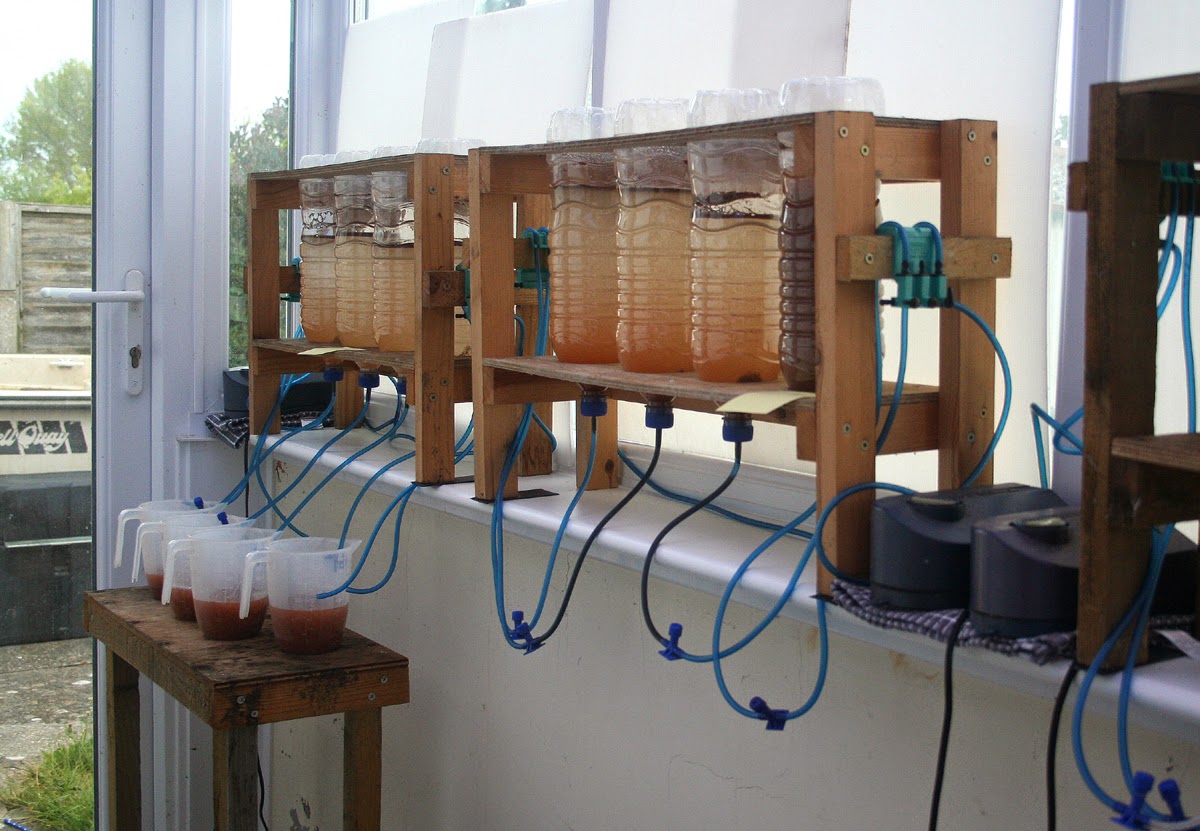
And so Brine Shrimp production gets into full swing (‘Health and Safety’ would have a field day throwing the book at us for this setup - Cables across entrance/exit points (the risk compounded by Trev’s ham-fisted clumsiness (bordering on dyspraxia), water within inchimetres of, even teetering precariously over, electric points..... Goodness; the risks we take...)... with twenty eight bottles on the go at the same time at four different stages of development which begins and ends every forty eight hours. A bottle is fed to each tank every morning and every evening for about four weeks. Brine Shrimps are the perfect protein packed mouthful for our newly hatched roach and even help stimulate their hunting instinct.... (If you can get your head around that) - It starts off as a great and exiting stage of the project, with our little roach just hatching, then seeing them take their first lot of our home-grown live food and begin to grow before our very eyes..... Then after just a couple of weeks it becomes a right pain in the bum, and we can’t wait to dismantle it all and chuck it back in the garage...

The live shrimps are siphoned off into jugs and are administered with a meat baster, meaning that only the shrimps and the salty water (which acts as a very mild anti-biotic) can be delivered to every corner of the tanks. It takes an hour and a half for each feed, which entails turning off the bubblers to the mature bottles, which allows the live shrimps to settle and be separated from the floating shells, siphoning, administering, then washing all the bottles and jugs, refilling with de-chlorinated water, salt and shrimp eggs..... No wonder we get hacked off with it...

And this is what we want to see. Tiny roach, not even a week old, bulging with pink bellies full of Brine Shrimps. It’s sights like this that makes all the grief of the Brine Shrimp production worth every second.

A nice close-up of our healthy, stuffed, little roach.

And even closer still.... We really should get a life...

This final shot really gives a good perspective of the size of these tiny little fish, seen here alongside dandelion seeds. Once we are happy that all the roach have hatched the spawning boards are removed from the tanks and chucked against the garage where they’ll be left until they stink like a baboon’s armpit before we finally get round to jet-washing them off and storing them for next year.


Thursday, 16 April 2015

Roach Project Filming with SKY TV 'Tight Lines'

Off the back of having delivered the greatest number of roach to the river in the projects history in March, we were quietly confident that the day filming with Sky TV Tight Lines crew on April 1st was going to deliver some suitably impressive fishy shots and sequences.
Having been stunned to silence at what we netted from the adjacent stew we were really looking forward to revealing the contents of the final one to be netted and delivered to the river, knowing there would be at least the same number, maybe even a few more.
Although we have been filmed a few times now and are far more relaxed with it, there is still an element of distraction, apprehension and self doubt (after all, who in their right mind wants to watch and listen to us two?) – starting every sentence with errrr or um, tripping over some fresh air, looking straight down the camera lens having just been asked to walk past it and pretend it isn’t there...... Then there is the absolute certainty that the moment it’s all over and the car doors slam and we all drive off home a whole barrel-load of profundities pour into the mind that you wish you’d thought of while the cameras were rolling.
It turned out that this day was to be no different, but with the skill of the director, Mike, the know-how of cameraman Ben and the steady, calmness of Keith, along with the snipping and cutting and skilful editing, we think they have made us look almost normal, but you can judge for yourselves as we have included a link to the film further down this blog entry.
All joking aside, it’s a real privilege to be asked to do a film for telly, and a wonderful opportunity to continue spreading the Avon Roach Project word.
Stills and captions and blogs are a great way for us to tell our story, but a well made film gives it a whole new level and pace and we are very lucky to have both.
The main thing is it shows the river receiving yet another dollop of thousands of our healthy adult Avon roach, which is what it’s all about. It also captures the great atmosphere of enjoyment, pride and fulfilment we can’t help radiating in this amazing bumper year for the project.
All in all the day went really well and we thoroughly enjoyed it, and once again have to offer our sincere thanks to our great mates for their help on the day; ever dependable Jim Allan who was the expert with the net, the pipes and oxygen – and cool shades; Jim Wreglesworth and of course Dickie Howell and his brother Martin. They all continue to make our lives so much easier.
This was the final one of five copious releases we have made this year and is very close to one of our annual spawn collection locations, so once again ensuring we always give more than we take.
Once the delivery of the fish was complete and the final sequence shot, we were treated to tea and the best banana cake this side of the universe by the land owner Peter and his wife Sandy back at the house.

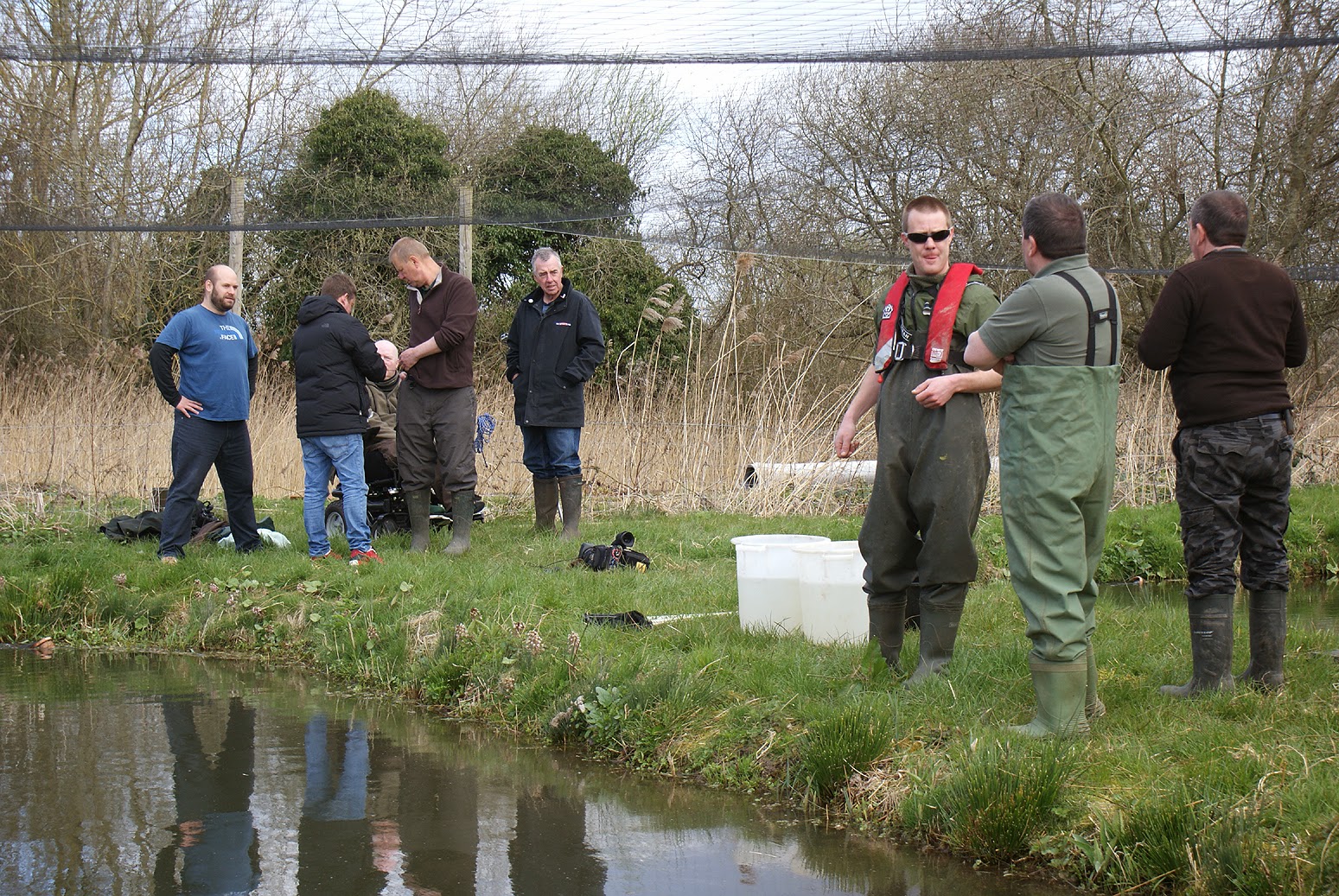
Rain was forecast for later in the day, but we still started with a ‘tea break’ and a laugh – just to lay the foundation to the day. Then it was on to the chosen stew to get started. Budgie led the way and made Cameraman Ben and Director Mike carry all their own gear.

                                                 A quick portrait photo for the blogs and press.

                                                                   Trev getting wired for sound.

                                Last touches to the sound equipment – and everything is ready to go.

                                     Last run through the format.

            Keith does his opening introduction sequence to camera.

             The net is laid around the edges of the stew in readiness and Trev explains what’s going on.

Cameras were clicking away all day, not only for personal and press stuff, but for the documenting of the history of what is happening here....

                                           Ben picks his spot...

                                         And we’re off. Jim Allan and Trev begin drawing the net in.

Once the two ends of the net meet, there is a slight relaxation in nervousness. We’re all thinking ‘there’d better be some bloody roach in there...’

Jim Wreglesworth gets the other end of the net and Jim Allan takes in the lead line..... Tension mounts... Breath held, knuckles white, mouth dry, excuses ready...

Then this little lot reveal themselves. What a haul of roach...

This is a reminder of what they looked like two years ago when they were put in the stew as little one year olds from our tanks.

Martin Howell takes over on the net as Jim Allan passes Trev the roach for placing into the barrels.

Ben continues with the loading of the roach into the barrels while Mike tries for some underwater shots with the GoPro camera on a pole.

Then it’s off to the truck and the oxygenated tank, where the fish would be happier and less stressed..... If only we could tell ‘em...

Time was fairly critical here with so many fish in the barrels, so we just got on with it.

                                                                         What a net of roach...

                                                                      And they just kept coming.

                              Cameraman Ben managed a few close-ups, poking in where he could.

                                         Once again, stunned silence at the sheer number of roach.

Once the filming and photo’s of this bit were done, Budgie and Keith set about telling each other jokes (or should that be fishing stories). Then it was off to the river.

Then it was almost the entire sequence in reverse. The roach are put back in the barrels for depositing back into the river.

                                                                  Jim hands Trev the first lot.

                                                                         The smile says it all.

                                               Trev tries not to stumble and fall in (he is pretty clumsy).

                                                           The first net-full get their freedom.

      There were enough nets of roach to be able to do, and re-do, all the talky bits for the film as we went.

                                 Smiles of amazement all round.

The feel-good atmosphere at dropping so many roach back into the river was impossible to hide.

                                              Last deposit for the camera, then it was science time...

We had separated about fifty roach so they could be measured and have scale samples taken for comparison with existing EA data on Avon roach taken from fish before our project.

We have taken this little sweetheart from egg to this, and just before being given her freedom, she plays yet another part in Avon Roach history.

Jim Allan carefully removes a couple of scales from each fish, which were then placed in individual envelopes and sealed. The size of the individual was written on the envelope.

It will give us a direct comparison with growth rates of our roach to those in fish from the river before we started our project.

No harm done, but a valuable source of directly comparable data. They were all then released into the river to join their friends. So, if you meet a three pounder in fifteen years time with a slight graze on her shoulder, say hello...
The link to the film is below...... We have also been a little indulgent and put the link to the film we made with them back in August below that, in case anyone wants a double helping of us (unlikely, without some strong medication and counselling).

Tight Lines April 2015

Tight Lines August 2014
Through one thing or another, there have been some temporary gaps in our inlets to the first stews we reinstated and we have long suspected that some of our roach have tip-toed out and have set up home in our feeder stream as we have noticed roach of various year classes living here. And we know the local herons always show an interest.
We have always seen the odd group of small fish which are not always obvious as there are all kinds of places for them to hide such as the huge pipes under the access paths and a lot of weed growth, and it’s not something we take much notice of as we have enough water to stand and stare into which we know to be full of fish, but lately we have suspected there may be more to this stream than we realise.
One of the things that has caught our attention is the presence of one year old roach in the haul when netting the last two stews, which were only excavated a few months prior to us stocking them with roach from our tanks two years ago, meaning that these little roach can only have come in through the inlet pipes from the stream as larvae, or indeed from the main river which feeds our stream – it’s that larval drift again, a vital element in what we are doing in the river, as when our released roach spawn this larval drift, along with adult migration and displacement will, over time, colonise areas we haven’t been able to stock our roach for whatever reason. However, little did we think we would be the beneficiaries of it in our own stews.
The other thing it highlights is that if we give these little critters even half a chance and the slightest of opportunities they’ll grab it with both fins. It also demonstrates the huge significance of these off-river back waters and streams as vital fry and juvenile habitat.
It all goes to show just how adaptable our roach can be when they get the chance.... Isn’t nature wonderful (sometimes)...?
As we sign off now we can report that all the first round of spawning boards are in the river, and we have been taken completely by surprise through the extraordinarily warm weather sending water temperatures rocketing and light levels soaring with a low, clear river meaning that the roach have already started spawning ten days earlier than we anticipated, and for only the second time we have known. So, the starting pistol is fired and off we go... Watch this space.
Finally, you can now follow our movements on our Facebook page – yes, us on Facebook. Who’d have thought...? Us embracing modern technology eh? There’ll be radiograms in automobiles next.      Please visit and give the page a ‘like’ and a ‘share.’ Link below...