Sunday, 23 February 2014

Storms and Roach Movement

 
Well, here we are in full ‘late winter panic mode.’ Not helped by the tiresomely stubborn and bothersome jet stream that has spent the last six weeks plonked right over our roof, bringing the worst rain and floods for more than a billion years.

The Avon up and over.
Budgie's barbel swim...
This is where we usually stop for a breather and a cup of tea while on
Bickton Roach Project duties. The stews are safe from the floods beyond this shed.
And, before we move on, we’d like to take our hats off to the Environment Agency for all the fantastic work they have done up and down the country in dealing with the unprecedented, brutal and relentless weather conditions that have affected us all in some way or another on differing levels, from off-the-scale heartbreaking and tragic devastation, right down to it just well and truly pissing us all off. Despite being run ragged, our EA mates even offered to roll their sleeves up and come and help with any emergency Roach Project duties on their days off. Now, who could ask for more than that?

Yet another of the countless victims of the storms.
I'm sure I've either leant or had a wee up against that tree
while stalking barbel...

Rows of trees beaten to the ground
by the storms.


And all the time we have had to put up with a telly-box crammed with pompous, ill-informed, glory seeking, political point-scorers, hacking lumps out of them for not spending more money than they actually had to prevent something that has NEVER happened before in the history of mankind. Blimey, what do they have to do to get some credit?
Anyway, off the soap box...
The conditions have put paid to our plans for a February roach release. Instead, we are going to wait for the river to get back within its banks and hopefully get them released before the water warms too much, possibly in May at the latest. Warm water and fish stress and handling can be a lethal cocktail, so best avoided.
We went ahead with getting the roach health checked from three locations due for release; this is courtesy of the Environment Agency who do this for us each year. The health check validity lasts for six months, so hopefully will give us enough of a window to get the release done.
What this means is that the roach will pass their spawning time of late April in the stews rather than the river, which is why we like to time the release as we do to allow them to settle and look to spawn soon after. So, we’ll place spawning boards in all the stews and collect their eggs, then relocate the boards and let them hatch in various parts of the river and in side-streams, then release the adults shortly after. This will mean the river will get what we intended, adults and eggs, but not in the order we’d hoped.
It’s always a wrench for us to have to send thirty roach, which is the minimum number required to be sure of detecting any problems, from each location to be health checked as, unfortunately, this health check isn’t just a squeeze of their privates and a request to cough, or the donation of a blood and urine sample; it means they have to die for the greater good of the rest of the thousands that will be given the chance of freedom and survival in the river.
The roach are checked for all sorts of diseases and fungus to ensure what we put back in the river are in good health and not carrying or suffering from anything horrid that could be passed on or affect the innocent occupants already in the river, and it is very gratifying to have the reports returned giving them a clean bill of health, which we have received in the last few days for all three lots we had tested. It means we are doing it right and giving the rest a fighting chance of survival.
We don’t, however, require a health check to move our roach from a Cefas registered fish farm to another Cefas registered fish farm, so from here at Project HQ to our stews at Bickton. We have, to date, as a matter of ‘good practice’ done so when moving our one year olds to the stews as there are so many of them, and to have them carrying something nasty only for us to look after them for a further two years seemed pointless. However, after all this time, and having never failed a health check, we feel we can now dispense with this and just relocate them to the stews; which we intend doing in the next month.
This was pointed out to us by our friends at the Environment Agency and also applies to our ‘Toddlers’ which you’ll remember are the ones we kept back from the first collection of spawn to grow on in one of our tanks. We split them into two tanks early in 2013 to ease the threat of stunting; and that was pretty much the last time we saw them. The only glimpse we get is a ‘light show’ of flashes as they take the regular helping of red maggots we make sure they never go too long without (about once a week through the summer months).
So, as mentioned in the last blog, we decided to move them to our big stew (stew zero) at Bickton where they can live out the rest of their lives just swimming, sun bathing, eating and drinking and procreating..... What a life?
We have collected and relocated spawn from these fish in the past, by placing  spawning boards over them in the tank at the right time and when they start to show signs, but didn’t expect them to spawn this year as we separated them a little too close to the time they would be thinking about it.


Our 'Toddlers' spawning in the tank a couple of years ago.
We dropped the water in the tanks and carefully scooped them all up in nets and put them in bags in bins, as we do the tiny ones for moving. We oxygenate the water in the bins, ironically, with live bait aerators, and transported them to their new retirement home.
Good friends and great supporters of the project Dickie and Martin Howell, who help us maintain the stews at Bickton, came along and helped, and we were all absolutely bowled over at the size and health of our ‘Toddlers.’ They were up to seven inches long and as bright and vibrant as any roach we’d ever seen; broad blue and silver flanks, deep red fins and as perfect as if the wrappers had just been removed or they’d just been minted.
First scoop...


And into the bin they go... You might be able to see our jaws hitting
the floor in the background...


We just had to touch a few of the really big 'uns. Don't they look great?
Then, to our utter amazement, we found about a dozen little ones. So they had spawned, probably on the side of the tank, and these were the survivors that managed to not only avoid one hundred and thirty five adults, but also the solids handling filter pump we have running constantly.

Our eyes nearly fell out of our heads at the sight of the first 'Tiddler.'

It’s sights like this that really galvanise our resolve and confirm that these resolute little critters deserve every ounce of help we can give them, as if they can increase their number by almost ten percent in a tank then, who knows, maybe our little spark might one day ignite the flame of recovery in the river.


Trev carefully corners the last few.


The bag in the bin, full of roach, is tightly sealed with a cable tie.


As you will gather through this blog and web site and indeed the project itself, while we carry a stratospheric level of blinkered determination to succeed in making a difference to the river, a common thread is always the balance of highs and lows, and while the work can sometimes appear very unrewarding, dull and repetitive, and fruitless for long periods; full of mud, rain, cold and fish pooh, this is punctuated with moments of enormous fulfilment and wellbeing with events like the sight of two hundred and seventy plump, broad flanked, red finned, adult, viable roach that we have grown from tiny eggs, not to mention their own tiddlers.

At Bickton Trevor and Martin walk the bins to the stew side under the
guidance/heckling from Budgie in the background - fuelled every few seconds
by Dickie who was on camera duty and taking all these wonderful shots.

At the stew with the first bin, and a welcome rest. The atmosphere crackled
with a blend of anticipation, urgency, pride and relief. Trevor still
laughing at Dickie's stupid jokes, his brother Martin, who is used to it all,
and Budgie in the middle wondering why everything has come to a standstill.

We opened the bag and simply had to touch a few more.

It was then a case of tipping the contents of the bags carefully into a net
a few at a time for release into the stew.

The first net of 'Toddlers.' What a sight.

We just had to get a close-up of that little lot.

The second net full of perfect roach. Have you ever seen a more delightful sight?

The roach are carefully lowered and released into the stew..... Aaaahhhhh!

...and another helping get their moment. We're never quite sure how many roach
pictures to cram on this blog or our web site..... So, we'll just keep going...

Have you ever seen more pride and relief pouring from one face?


The final net full go in. Trev reckoned it was difficult stooping that low
as his chest was so inflated with pride.

The 'Tiddlers' went in the stew with their parents.

One of the tenacious tiddlers gets a helping hand.
We’ll collect spawn from these roach each year by placing some of our spawning boards in the stew at the right time, then simply relocate what will be quite a substantial amount of spawn, given the size and number of them, and let the eggs hatch in various locations along the river. One or two can even be placed in the fry bays and habitat restoration sites we have been involved in. We’ll distribute the spawn all over, but not take it to grow our own adults in tanks as we don’t want to run any risk of creating even the slightest genetic bottleneck. We work extremely hard in retaining the genetic integrity of the strain through the way we do things, so the last thing we want to do is stifle it in any way through our own laziness – not something we have ever been at much risk of being accused of

So, by relocating thousands and thousands of eggs taken from our own, along with the spawn laid by the adult roach we have reintroduced through the years we hope that at certain times of year (early May) when these hatch the river will have enough tiny roach being wafted down the entire middle reaches that the species can, in time, once again take a grip and recover.
By careful placement of our adults and relocated spawn there should be nowhere on the river that avoids a helping, however small, of our roach; from Breamore, down through Fordingbridge, Bickton, Somerley, Severals, Bisterne, Sopley, Winkton and down to the Royalty.....Wow! Best stop going on about it and get to work...


Monday, 23 December 2013

2013 - General Project Update


We left the last update on the 2012-13 section of the web site with the news that the roach had started to spawn on our boards. Here we are at Christmas, and we’ve only just found the time to tell you how they did..... Sorry.
You’d think by now that we’d have gotten a bit of a handle on this here roach rearing lark. Well, I guess we have to a great extent, but continue to learn, sometimes on an almost daily basis. However, there are some things about Mother Nature that we will never ever get to grips with.
'Unpredictable’ is probably the most commonly used accusation, and yet you could set your clocks by some of her cycles..... Brutal, fickle, erratic, volatile, uncompromising, and the list of insults goes on; yet take a slightly more open hearted look and you will be taken apart with shear wonder at what goes into the making of what we so often take for granted.

Despite our extremely blinkered focus on our roach, our fascination and enthralment continues to be bolstered at every turn, and this all starts each spring with them gathering at our spawning boards, the sight of which rouses feelings of utter delight and relief that never diminish, no matter how many times we see it. We sometimes spend hours just watching them, especially as we remember that they are romping all over something we have made with nets and nails and planks, and has been leaning up against a garage wall all winter. 

It is generally accepted that the trigger to spawn each year is a combination of rising water temperature and increasing day length. This, fairly predictably, happens sometime in late April or early May (sometimes not at all, so some say), along with the arrival of the swallows, the grannom hatch, the first bumble bees and brimstone butterflies and the supermarkets trying to sell us BBQ charcoal and Speedo’s. 
Well, through our years of running the Roach Project and our close connection to the species we have managed to get to grips with quite a lot of roach and river stuff, but the one thing that leaves us open-mouthed is the fact that for four of the six years we have been doing this, the roach have spawned on our boards on exactly the same day, the 25th April. Not only the same day each year, but throughout the river with differing water temperatures of as much as three degrees from the most northerly to the most southerly location, which are some fifteen miles apart. On one of the two years this didn’t happen, they were seen on the afternoon of the 24th gathering at the boards, only for the river to flood through the night with the biggest rains for decades putting them off until the first week in May. The other year, due to an early spring ‘heat wave’ they spawned in the first few days of April. We think this is where the ‘sometimes not at all’ belief might have arisen. After all, who’d think to look for spawning roach before mid April anywhere?
It is, after all, just a fish; so how do they do it? And what happens on a leap year?.... Only kidding.
25th April and spawning commences.
We are sure that some of the smaller ones here are our own.
On the same day the roach begin spawning
in a carrier ten miles away. Our small ones are
also seen here, though these are whoppers.
 
This fellow almost rolled over the spawning board. Exciting eh?
Just as an aside, we are in an extremely fortunate position (though with an arm-full of wasp stings, wellies full of mud and nose and eyes full of mozzies the size of pigs, we sometimes take a bit of convincing) in so far as our spawning boards reveal roach of all sizes that would ordinarily remain unseen. This year, as last, we saw a good number of smaller fish visiting our boards which, having ensured we reinforce the population from where we borrow the spawn are, in all probability, our own. We were also uplifted to see good numbers of big roach; some very big roach…….. Some, the stuff of dreams. We were blown away at the sight of at least five three pounders and many two's in at least three different locations.
It is now widely considered that the legendary ‘big Avon roach’ are a thing of the past. However, having seen what we have this year, we can state emphatically that the Avon is still doing what the Avon has always done. She is still making big roach. She just isn't doing it on the same scale.
So, if the seed of scepticism has germinated, we urge everyone to keep the faith. Avon legends are not only a thing of the past, but are of the present, and we believe of the future too...
25th April again and the roach start spawning on our boards in the fierce flowing water at the
tail of a weir in the main Avon. One of these fish is huge.

                                 Some real ‘lumps’ visit our spawning boards.
With the commencement of spawning comes the excavation from the garage, cleaning and testing of all the component parts of the Brine Shrimp Hatchery, which is rigged up in rediness for the first hatchlings. The shrimp cysts are added to the bubbling water a few days after the first lot of fish are seen in the tanks, meaning their first live feed will be timed for when they are about five days old. The amount of feed is gradually increased over about a week and a half to allow the roach to finish hatching, when all twenty eight bottles will then be in use. It then continues to be gradually increased in volume per bottle to allow for the requirements of the, hopefully, growing fish. 
                Our ‘Brine Shrimp Hatchery’formerly known as Trevor’s conservatory.
We separate the live shrimps from the shells by simply turning off the bubblers to each bottle allowing the shrimps to fall in the water and the empty egg shells to float. We can then disconnect and drain the shrimps through pipes and valves under the bottles. It is important that we don’t feed too many of the egg shells, especially at the very early stage, as this would be like us swallowing a cup and saucer. We might get them down, but we’d have a bit of a job digesting them, and even more of a job passing them...
A close-up of the separated brine shrimps, ready for siphoning into jugs for
administering to our hungry hatchlings.
                                                   Siphoning jugs of goodness.
Sounds simple, doesn’t it?.... Well, it’s bloody well not! It’s all hard-earned guesswork and luck that has been finely honed over the years. But as this hasn’t been done before, our only option is to turn gut feelings and instinct into knowledge and experience.
The period between placing the spawn laden boards in the tanks and the wait for the first fish to hatch is a strange time, but one of great expectation, slight worry and anxiety, with nothing to do but fret and argue and wait for the starting pistol to be fired at the sight of the first little roach.
This year we used some of this time to take some more under water photographs with our little happy-snap camera in the hope that we could get a sequence of pictures showing the development and maybe even the actual hatching. So, from the moment the last board was placed in the tank, the camera was set clicking away from all angles. We must have taken, without wishing to exaggerate, about three thousand million billion trillion gazillion pictures...  And ended up with about a dozen or so that we think are truly amazing. Next year we’ll take even more.
Almost ready to pop. Eggs within hours of hatching.

Say hello to John, Paul, George and Malcolm.....
Well, you can’t call a roach Ringo now can you? Even we’re not that daft –
Ringo the roach?


Hatching commences and life’s struggle begins....
Starting with a little wriggle and a flutter within the egg, then a tail breaks through and
the little fish reverses out into the world hoping that he will be the lucky one.
Little do they know, these are all our lucky ones...


Immediately after hatching the roach stick themselves to the first inanimate object they
bump into with an adhesive gland on their head, where they stay to take up their yolk sac.


        The spawning boards and the sides of the tanks are perfect places to hang out.

                             After a few days they are swimming free, but hungry.
We mentioned in our last update on the 2012-13 section that we didn’t expect this year to be anywhere near as productive as last, due to the cold winter and lead up to spawning. However, we are delighted with the numbers we have in the tanks; slightly down on last year, but impressive, nonetheless. It just goes to show how adaptable and resilient roach can be, if given the chance.
Roach meet brine shrimps for the first time. Pink bellies show we got it right.

                                     At one week old, just tiny splinters of life.

                                             Growing well at a few weeks old.

               Pink bellies show the full little roach and the brine shrimp doing the trick.


From eggs, then tiny fragile splinters of life and on to this...Our ‘toddlers’ being spoilt
with one of their regular helpings of red maggots courtesy of Richard at Ringwood Tackle.

The two new twelve foot tanks (and the replacement six footer), delivered by our friends at the EA, were quickly levelled and bedded in and are now full of roach. One has been given half the ‘toddlers’ from the middle tank as we thought they might start to get a little crowded and cease spawning. These, you’ll remember, are the ones (270 in total) we kept back from the first spawning to see if we could grow our own adults right here at Project HQ, and to see if we could get them to spawn; both of which we are proud to be able to say we have done. The other is now full of last years’ leftovers, which are the ones left in the tanks when we drop them and net the one year olds for movement to the stews. They were earmarked for stocking into a flight pond we were due to be given for future cropping of adults and spawn, but this wasn’t deep enough so we kept them back and will be depositing them into the river early in 2014.
Work gets started on getting the new tanks in place and levelled.

             Neat and tidy and full of roach... and even less grass to mow. Mad, isn't it?

As we sign off now (mid December) we are in the throes of getting all the winter chores done like jet washing the spawning boards and stripping the netting off and making new ones from those that need it as the old wood begins to disintegrate from years of being hurled into the river then lovelessly stood against a garage wall for the rest of the time. We try to get as much of this done before the post Christmas panic grabs us as every day and week seems to get fired at us at increasing velocity the closer to April we get. During this time we will need to have prepared stews, moved fish, scrubbed and cleaned and refilled tanks and filters; will have argued, blamed each other for coming up with this bonkers idea in the first place, and eaten cakes and pies and pasties galore...
Aside from all the mucky stuff, we are preparing to move our one year olds from Project HQ to our stews at Bickton. We are also contemplating moving our ‘Toddlers’ from here to our big stew and let them live out their lives there. We’ll still be able to use it to grow the fish from one to three years for release into the river, but will be able to collect spawn from these old ‘un’s each year and let that hatch in different locations in the river.
To release these ‘toddlers’ into the river we would need to sacrifice thirty of them for a health check and we feel we have invested far too much in each of them to do this for such a small number that probably wouldn’t be the most street wise anyway, having lived in tanks for five years and lived the ‘life of Riley’ where the only competition regarding food has been for the space it takes up.
We are also setting things up for the release of our two and three year olds into the river, possibly in late February, in probably a fairly high profile event, just to keep the project on everyone’s radar. Hugh Miles is going to film it, so it will add yet another sequence to our little film. We might be getting some press coverage too.
So, much more BLOG material.


Sunday, 8 December 2013

Annual Fundraiser Doo...


OK, pick your bottom jaw up off the floor. Yes, here is an Avon Roach Project update and the first BLOG. We are as surprised as you, believe us.
We are always being told off for not updating our site as often as people would like; and to be honest, we would love to be able to report far more often than we do. After all, as those of you who know us know, we love talking about our roach and our project. We’ve had hind legs falling off donkeys wholesale.

However, just as we are about to write something, something else happens and we wait to include it; then something else, and something else, and... So it goes on. And, the facility to upload information as and when, is slightly beyond us, or has been ‘till now.

With this blog we think we can fill in some gaps and give a little more day to day and behind the scenes stuff, if anyone’s interested.... There might be a lot of mud, moaning and mediocrity though, so brace yourselves.
And while it may not be as carefully honed as the general web updates; more a case of us just rambling on, we do feel that we can generally have some fun and have quite a lot to say. Hope so.... We’re sure you’ll let us know if we are hitting the spot..... or not.
Our good friend and supporter Hugh Miles does a great blog and when we are with him he is always stopping, saying ‘I must get a picture of that, or you in front of that, for the blog.’ Two minutes later and the day resumes with him having got the image he needs. We just need to get into the same mindset. Have a look and you’ll see what we mean on http://hughmiles9.blogspot.co.uk/ 
So, excuses over, now for the moment of truth.......
Once upon a time, long, long ago, far, far away in a deep dark forest lived a little Avon roach called Graham who had almost no friends left...... Just kidding!
We’d like to start with a blog about our annual fundraiser...
ANNUAL AVON FUNDAISER
On October 5th we held our fifth annual Avon Fundraiser Event, which is the lifeblood of our project, together with the donations we receive throughout the year from a whole raft of wonderful kind and generous folk. And, as we drive away from the hotel at sometime after midnight, we wish with all our hearts that we could turn the clock back and do it all over again. Not for the money, but for the amazing atmosphere throughout the whole day and particularly in the room in the evening. The show of support and belief in what we are doing is truly eye-watering. We really do have to pinch ourselves sometimes.
The day consisted of a friendly fishing match to the death followed by a three course meal at The Tyrrells Ford country hotel. This was then followed by an auction of some sixty fabulous lots, from exclusive guided and guest fishing days, signed books and DVD’s, rods, reels, pictures and an exclusive centrepin made and engraved especially for this event. There was also a special section of lots donated by avid Roach Project supporter and good friend Chris Yates which included signed books, a reel and a special float once owned and used by the legendary Bernard Venables.
We have been doing this now for five years, and while the organisation of it all still sends us into orbit, with stress and anxiety levels off the scale, we are reminded every time just how lucky we are to have the level of support we do.
We have learned a great deal over these years and with a few tweaks of the format and timing, plus the pre-event organisation of the running order of auction lots and the production of a lots list/running order/catalogue, call it what you will, we felt this years’ event was the smoothest yet. 
Even we enjoyed it, and managed to stop worrying about what could go wrong or if everyone was having a nice time.
This year we are delighted to be able to report a number of firsts and milestones.
The friendly fishing match to the death that we hold on the day, which is a pretty informal affair, with a lot of wandering, chatting and tea drinking, is decided by the best specimen of any species, so a two pound gudgeon gets it over a four pound seventeen ounce barbel, and the Avon being the Avon has always made her cries for help heard loud and clear, with all previous matches returning a very average stamp of fish and always in fairly small numbers.... and never producing a single roach.
This year we got our own back. Regular supporter Kevin Dyer took the trophy with a magnificent barbel of 14lb 1oz, the first ‘double’ ever to be taken at one of our gatherings.
Also, for the first time in the five year history of the event, roach featured in the catch returns. So, maybe, just maybe, we are actually making a difference.
Finally, this years’ attendance was a record at seventy three, as was the total amount raised, which was over six thousand pounds; in fact, with donations it was nearer seven thousand.
Kevin Dyer with his magnificent match
winning barbel, caught on a wooden rod
and a meatball. Nice one Kevin...
A not so quiet corner of the dining room.
If only the atmosphere could be bottled...
Trevor gives his end of evening speech with a genuine lump in his throat
and a tear in his eye. He says if he could find a word that meant
thank you ten times over, he’d probably still use it ten times over.
The first thing to benefit and be made safe with the funds raised at these annual events is our Roach Project and as we say, with tedious regularity, the project has moved way beyond the days of sponsored haircuts, half beard shaves, burglary, prostitution and drug dealing, and way passed being of elastic bands, string, sellotape and sticky-backed plastic. We now have the luxury of being able to just get on with growing roach for the Avon without the financial burden that projects such as ours are often severely inhibited by.
As funds have allowed, we have been reinstating a row of disused trout stews at Bickton, just south of Fordingbridge, and a mere Wallis Cast from where the legendary Capt. L. A. Parker used to enjoy catching roach of a size and in numbers that dreams are made of. We sometimes wonder what people like him would have made of what we are doing and, more sadly, why. 
We have had to do it in stages over the past four years and have just completed the last in the line which should allow us to virtually run the second phase of growing our roach almost exclusively from here.
Stew zero almost complete.
We call it zero because we already have
a stew one..... Don’t ask.
Stew 3.5 complete and being filled.


Stew seven (which is actually stew nine)
with the digger in the distance giving it all
a sense of scale and perspective.

We will be placing what we currently have in the tanks at Project HQ in the most recently excavated stews, but already have last years’ roach growing strongly in three of the others, and the lot from the year before in the remainder. These will be ready for release into the river, hopefully, early in 2014. These are already showing signs of maturity, with red fins and broad flanks. If river conditions allow us to release them early enough for them to settle down, they should look to spawn in April.
While we sometimes get caught up in our own little Roach Project world and get battered by all that needs doing, the mud, the midges, the cold... It’s sights like these roach in our stews, our roach, grown from eggs, and now on the brink of sexual maturity, along with the knowledge that we have such boundless support from wherever we turn, countrywide, that lifts our spirits and drives us on.


Our 2+ roach feeding in stew one at Bickton.

And a close up of what lurks in our Bickton stews,
and almost ready for release back into the Avon.

Beyond our project, the Avon itself is to get the shot in the arm it so desperately needs and will benefit directly from the funds raised at our doo’s by way of habitat reinstatement, enhancement and restoration schemes funded, or part funded, by us.

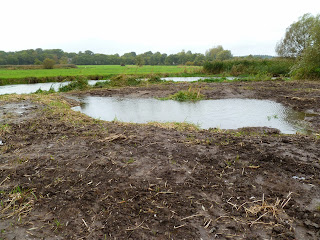
Our first habitat reinstatement project in partnership with the EA and Barbel Society, the Bisterne fry bay, put off from last year because of the wet conditions, is now complete and, we are told, was full of fry within a day of its completion.
Bisterne fry bay before we got the digger in...

And after, and full of fry. Aaaahhhhh!
Don’t you just love it when a plan comes together?...


There are a number of other habitat reinstatement and enhancement initiatives in the pipeline with the most substantial, and already completed, being at Severals, just south of Ringwood, where there are a number of flow deflectors in place and fry bays excavated. This is a partnership run project with the Environment Agency, Avon Roach Project, the BS, RDAA and WCSRT. The works also attracted the interest of the Mayor of Ringwood who was invited along to visit.
Three of the fry bays we helped with on the Avon just south of Ringwood.


The more the merrier...

The more of these slacks we can create and reinstate, the greater chance
of the rivers recovery in terms of fish populations of all species.


We are planning on putting some of our roach in the river here early next year.
These projects are a vital and priceless element in the continuing recovery of our river. The more fry and juvenile protection we can create the better, and not only for our roach, but for all species of fish.
We are starting to receive a number of calls, emails and messages telling us of the capture of small roach from various parts of the Avon that have benefitted from our releases, and while we have no guarantees that these are ours, they have been non-existent for so long that the coincidence is too great to ignore.
So, if any of you guys are out and about and start catching roach, we’d love to hear from you. Please just send a short email telling us your story and maybe a picture or two.
In the future, as the project progresses, we might share these messages on this blog with everyone who is interested in the development of what we hope will be the projects eventual success.
We’d like to sign off by thanking everyone for their support, both at the event and up and down the country, who donate financially or with their physical help, or who simply write and email us with wonderful messages of support and encouragement.
A short film was made of the fundraiser day by the very talented young brothers Carl and Alex Smith, who some of you may be familiar with through their work with the mainstream angling press and YouTube.