We get a bit punch-drunk at
this time of year from all that has to be done, with all the fish movements
from stews to river and tanks to stews, then the scrubbing and preparation of
the tanks in rediness for the next lot of hatchlings. Along with an induced
algal bloom, the tanks are seeded with daphnia which we grow in an assortment
of bins and barrels around the garden. These thrive on the green algae (if we
manage to get it going) and squirt out live young every week or so; so
hopefully, by the time we have collected spawn and hatched roach in the tanks,
the water will be alive with little critters for them to get started on........
Or do we think too much???
We always place the first
round of spawning boards in the river in plenty of time, which is the first
week in April, ready for the roach to spawn on the 25th (as they
have done on four of the last six years), all the while hoping that Mother
Nature will be kind to us and not run us ragged like she did last year with a
monster flood, heat wave or mini ice age.
We were dealt a slight
surprise this year with the unusually warm beginning to April which, coupled
with the clear river, triggered the roach to commence spawning ten days early;
something we had only ever known once before - so the starting pistol was fired
just as we were getting ourselves into the starting blocks.
Once again, we were rendered
dumbfounded as the roach throughout the river from just south of Salisbury down
to Christchurch, some twenty miles apart, all began spawning on exactly the
same day..... Awesome!
At one location we were
treated to something we’d not seen before. In a smallish
private stream behind some riverside apartments, the roach hadn’t arrived at
the spawning boards, but being as the head of the stream is accessible to us
all round and while we were having a coffee break with one of the owners, we
noticed the roach about thirty feet below the boards nervously, but obviously
on a mission, slowly moving upstream en masse.
It
was clear that they seemed nervous in this open and fairly featureless part of
the stream, but with an unerring urge to carry on up.
They moved only about ten feet in the half hour we were there. It was amazing to watch.
We
know that once they reach the boards and get going all inhibitions leave them
and they just get on with it, but the approach was something we’d never
witnessed. We always thought the upstream advance was a more speedy
and determined affair, but then I guess that nervousness and vulnerability
means caution needs to be exercised to ensure survival – and besides, what the
heck do we know about all this stuff anyway?
By the afternoon of the 15th
the roach were all romping away nicely, and with the unusually clear water we
were able to get some really good pictures, which you can OD on below......We
have!
We never tire of seeing the
roach spawning and always spend time taking plenty of photographs. We regard
ourselves as very lucky and the feeling of satisfaction and pride we get from
seeing them spawning all over our spawning boards – something we have made from
a plank and some netting, tied to a rope and chucked in the river – is
indescribable (there is much more to it than that, as you know – we’re just
being facetious).
Unfortunately, there is also
an unpleasant side of watching roach spawning; or at least being there at the time
they are spawning, and that’s seeing the remains of the night time attentions
of the local otter at one location. For the last couple of years now we have
seen the remains of a big roach taken while spawning. This year there was a
double downer, as the day after finding the scales and fins of the big roach,
we found the remains of a very big signal crayfish in the same spot, also eaten
by the otter, which was in all probability grazing on the roach spawn on our
boards.
(Just to set the record
straight – The roach spawn at these set locations every year and the otter and
the crayfish would be there regardless of whether we float a spawning board
over them).
Anyway, enough of that –
back to the plot...
After a few days of balmy
warm sunshine and spring arriving at pace the temperature dropped like a stone,
so the Speedo’s went back in the drawer and the lined trousers, thermals and
woolly jumpers were reinstated.
Usually, it doesn’t matter
what happens to the temperature once the roach begin spawning; once they’ve
started they usually just continue for a week or more regardless. However, this
year, at a couple of locations they ‘switched off’ and disappeared.
This didn’t really make much
difference in terms of egg collection as we have a series of set routines all
triggered by roach behaviour and time of year, but it certainly made a
difference in terms of egg development
and hatching.
Hatching
of the first laid usually begins some ten or twelve days after spawning; then
is usually all done within the week, during which time our ‘Brine Shrimp
Hatchery’ is excavated from the garage and set up in the conservatory and the
live shrimps are hatched and fed according to the hatch rate and therefore
volume of the requirement for food.
This
year hatching has taken more than an entire additional week, as the development
of eggs
slowed to an almost standstill in the very cold
water.
With
our little happy-snap camera we can get some underwater pictures of the egg
development, if we’re lucky. We usually take pictures every day once the eggs
are eyed – partly because we love seeing them and can post them here and on our
Facebook
page, but more importantly it allows us to see when
the roach begin to hatch and in what volume, as it isn’t immediately obvious as
they spend the first few days just hanging from an adhesive gland on their head
from the nearest inanimate object (usually the netting or underside of the
spawning boards) absorbing their yolk sac before detaching and swimming free
looking for food, which we need to supply them with.
From
probably just short of a thousand pictures we have managed to get a couple of
dozen fairly good ones, some of which we have included below.
The
rise in temperature got things going again and they have all now hatched,
meaning our stress levels
are back on ‘Overload’
again...
We’ll leave it there and
stop rambling on and let the pictures and captions below do the rest of the
talking.
Please keep an eye on our
Facebook page and if you haven’t done so yet then please give it a ‘like’ and a
‘share.’
 |
The roach head upstream and gather at our spawning boards. What a fantastic sight.
|
 |
Then away they go. It never ceases to amaze us just how irresistible our boards are to the roach. These are within thirty feet of a wall of fontinalis, which they completely ignore in favour of our artificial offering.
|
 |
At another location, but on the same day, the roach also began spawning, and we can confirm that a few‘Avon Legends’ still exist. This isn’t a very inspiring shot unless you consider that the spawning board is nine inches wide – so how big must this roach be?
|
 |
The action can be explosive...
|
 |
At a couple of locations we are able to get right over the spawning roach to get shots like this.
|
 |
It might all just look like a random free-for-all but it is far from it. We even see males seeming to be holding and protecting territory along the spawning boards.
|
 |
It’s all a matter of getting in the right place at exactly the right time.
|
 |
Then when the female releases her eggs it is an all out brawl to get in on the action.
|
 |
Sometimes it seems a far gentler affair as the male tenderly rubs his tubercle covered body against the female to induce egg release. We think the texture of our netting on the spawning boards may do the same, but we’ll never know.
|
 |
Sometimes the camera shutter just happens to be open at the exact right moment.
|
 |
Water clarity and light levels meant that we were very lucky this year and photographing was made much easier – we still spent countless hours watching and snapping though; wouldn’t you?
|
 |
It’s always good to see a few real brutes contributing spawn each year.
|
 |
The camera shutter was set on ‘continuous’ and this was the same group of fish one third of a second later. This might give an indication of just how many pictures we have to take and just how bloody lucky we are.
|
 |
This is one of our finest and you can see the tubercle covered male at the top actually discharging his contribution to the next generation.
|
 |
The ‘light show’ sometimes is breathtaking.
|
 |
Five yards downstream and another spawning board gets some attention.
|
 |
This shows the sad side of it all. The two pence piece wasn’t the loose change that fell out of its pocket, but was placed there by us as a size reference. We estimate this roach to have been over two pounds – certainly more than ten years old and probably less than ten minutes to disappear...
|
 |
The following day in exactly the same spot a signal crayfish taken by the otter. It was probably grazing on roach spawn.
|
 |
After a few days we replace the spawning boards with fresh for the roach to continue spawning and remove the first lot of eggs. This picture shows a particularly good coverage. We have to do this to prevent the roach from overloading the spawning boards as they use them exclusively and in preference to any natural substrate. They continue spawning on the replacement almost immediately. We have even had them spawning while we are retrieving the board. It’s quite something to have roach spawning on it while you are holding on to the other end of the rope.
|
 |
It usually takes between ten and twelve days for the eggs to hatch, depending on water temperature. However, as we have said above, this year has seen the cold snap prolong hatching by about a week. This picture shows the tiny fish inside the eggs within hours of popping out. Some of the eggs are no longer round as the little fish begin to straighten and force their way through the outer membrane.
|
 |
And, we just had to show you another; possibly within minutes of hatching. So, a thousand pictures for just a few real corkers like this.
|
 |
Then hatching commences..... And, of course, there was a camera pointing at them.
|
 |
Despite having taken thousands of pictures of this Roach Project over the years, we never managed to get one of a roach actually hatching – until now. The fish just left of centre of this shot is actually backing out of the egg with its head still inside. The one below it is almost out too.
|
 |
It’s when we get pictures like this, showing the roach in numbers hanging from the underside of the spawning board, that we know to get the Brine Shrimp Hatchery up and running to make sure they get plenty of feed when they need it.
|
 |
One of the first to swim free – a future three pounder perhaps... It’s humbling to think that the beautiful, plump, red-finned bruisers we see spawning on our boards all started life like this. What we are doing is simply stepping in with a little help to increase the odds.
|
 |
And so Brine Shrimp production gets into full swing (‘Health and Safety’ would have a field day throwing the book at us for this setup - Cables across entrance/exit points (the risk compounded by Trev’s ham-fisted clumsiness (bordering on dyspraxia), water within inchimetres of, even teetering precariously over, electric points..... Goodness; the risks we take...)... with twenty eight bottles on the go at the same time at four different stages of development which begins and ends every forty eight hours. A bottle is fed to each tank every morning and every evening for about four weeks. Brine Shrimps are the perfect protein packed mouthful for our newly hatched roach and even help stimulate their hunting instinct.... (If you can get your head around that) - It starts off as a great and exiting stage of the project, with our little roach just hatching, then seeing them take their first lot of our home-grown live food and begin to grow before our very eyes..... Then after just a couple of weeks it becomes a right pain in the bum, and we can’t wait to dismantle it all and chuck it back in the garage...
|
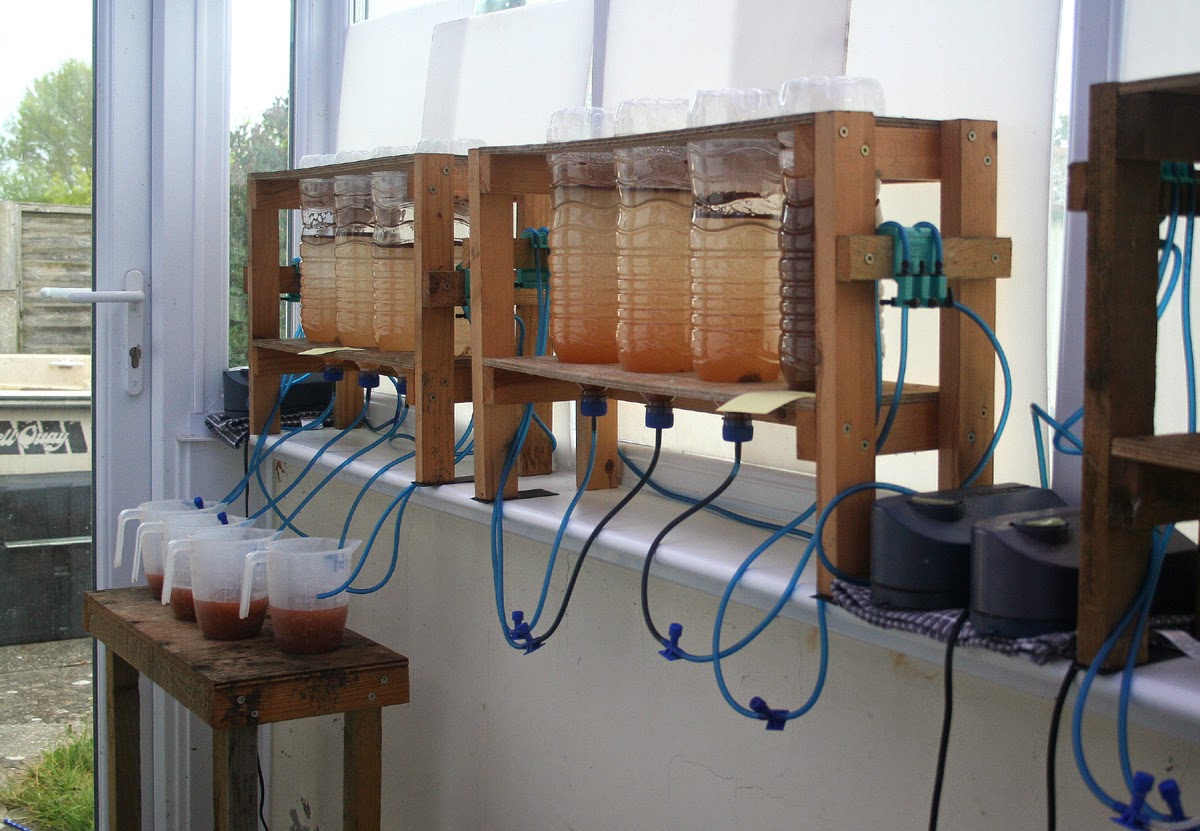 |
The live shrimps are siphoned off into jugs and are administered with a meat baster, meaning that only the shrimps and the salty water (which acts as a very mild anti-biotic) can be delivered to every corner of the tanks. It takes an hour and a half for each feed, which entails turning off the bubblers to the mature bottles, which allows the live shrimps to settle and be separated from the floating shells, siphoning, administering, then washing all the bottles and jugs, refilling with de-chlorinated water, salt and shrimp eggs..... No wonder we get hacked off with it...
|
 |
And this is what we want to see. Tiny roach, not even a week old, bulging with pink bellies full of Brine Shrimps. It’s sights like this that makes all the grief of the Brine Shrimp production worth every second.
|
 |
A nice close-up of our healthy, stuffed, little roach.
|
 |
And even closer still.... We really should get a life...
|
 |
This final shot really gives a good perspective of the size of these tiny little fish, seen here alongside dandelion seeds. Once we are happy that all the roach have hatched the spawning boards are removed from the tanks and chucked against the garage where they’ll be left until they stink like a baboon’s armpit before we finally get round to jet-washing them off and storing them for next year.
|